
Genesis Part 4: Stretching of the Space-time
- Feb 28, 2018
- 4 min read
Updated: Mar 1, 2018
Summary
Following the placement of space-time, ‘waters’ and ‘light’, God introduced the ‘firmament’ to stretch out and expand the Universe on the second day. The ‘waters’ (dark matter), ‘light’ (ordinary matter) and ‘firmament’ (the inflationary force that stretches the space-time) remain the building blocks of the Universe we see today.
Discussion
Genesis 1:6 And God said, Let there be a firmament in the midst of the waters, and let it divide the waters from the waters.
Genesis 1:7 And God made the firmament, and divided the waters which were under the firmament from the waters which were above the firmament: and it was so.
Genesis 1:8 And God called the firmament Heaven. And the evening and the morning were the second day.
(Source: KJV)
‘Firmament’ (Hebrew word raqia) used in Genesis 1 has long been a point of contention among critics of the Bible as it reflects a non-scientific view of the cosmos. What is the meaning of the word ‘firmament’? According to the Online Etymology Dictionary (1), Firmament is defined as firmamentum in Latin, literally a support or strengthening, from firmus “firm”, used in Vulgate to translate Greek steroma firm or solid structure,” which translated Hebrew raqia, a word used of both the vault of the sky and the floor of the earth in the Old Testament, probably literally “expanse,” from raqa “to spread out,” but in Syriac meaning “to make firm or solid”.
‘Firmament’ as a noun
In many Bible versions, ‘firmament’ is translated as ‘canopy’, ‘dome’ or ‘vault’. The interpretation of ‘firmament’ by the ancient Greeks and Hebrews as a dome structure or a solid support invited much criticism as we know that such solid structure does not exist in space. However, if one interprets the ‘firmament’ as the fabric of space (more accurately space-time – Part 1), the meaning of ‘firmament’ comes clear in modern definitions of cosmology. Genesis 1 defines ‘firmament’ as the space in the Universe where sun, moon, and stars give light to the earth. This space, which God calls heaven (Genesis 1:8), is uninterrupted with the rest of the space-time in the Universe. It is the same space-time fabric that God displays all the celestial bodies. The New Living Translation has replaced ‘firmament’ with the word ‘space’. Other Bible versions have adopted terms such as ‘horizon’ or ‘expanse’ in their translations.
‘Firmament’ as a verb
The Hebrew noun raqia (‘firmament’) is derived from the verb raqa, which means “to spread abroad, stamp, or stretch.” The use of ‘firmament’ in Genesis 1:6 to separate ‘waters’ from ‘waters’ also infers the presence of a dividing or inflationary force (Genesis 1:6). Furthermore, the books of Job and Isaiah teach repeatedly that God alone ‘stretch out’ or ‘spread out’ the heavens (Job 9:8, 37:18; Isaiah 40:22, 51:13, 42:5, 44:24). If ‘firmament’ is the spacetime of the Universe, what does stretching or the spreading of the ‘firmament’ (space-time) mean?
Hybrid meaning
Taking it together, ‘firmament’ has a hybrid meaning of both a verb (i.e. stretch) and a noun (i.e. space-time). It represents the stretching of the space-time, which carries a specific and significant meaning in the story of the expanding Universe in modern cosmology.
The expanding Universe
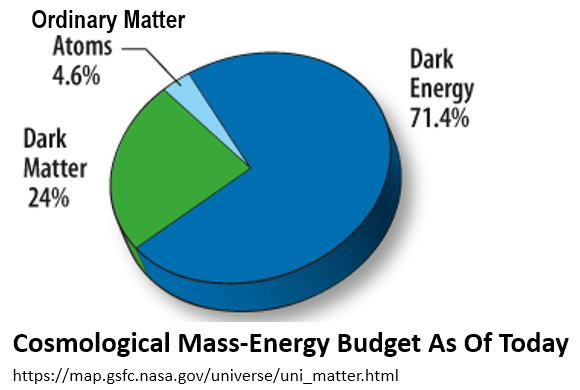
The story of an expanding Universe started with Edwin Hubble in 1929. He observed that almost all galaxies were moving away from us. What’s perhaps the most perplexing about these galaxies is that the farther away we find them, the faster they are receding from us. Even with the initial expansion of the universe, gravity from ordinary and dark matter would expect to halt the expansion and bring the Universe into equilibrium. In 1998, two teams of scientists set out to study supernova to trace the history of contraction. They were surprised to learn that Universe was not contracting but doing the opposite. In fact, its expansion rate has increased. In another word, if you and I were looking at each other from two adjacent galaxies, the distance between us will be greater tomorrow than what it is today. It is important to note that only the spacetime between galaxies and galaxy clusters is expanding and not the galaxies or clusters. The expansion energy of the spacetime, called dark energy, permeates the entire universe and is driving the acceleration of the Universe expansion. Dark energy is the largest component in the mass-energy budget of this Universe in addition to dark matter and ordinary atomic matter (Part 2).
When we look up into the sky, the Universe seems to fill with empty spaces. But space is not empty and filled with nothing. The first thing God created was the fabric of the Universe that Einstein called spacetime. God placed in this fabric all the celestial bodies including dark matter (‘waters’), stars and planets. Stretching of the space-time leads to an acceleration of the expansion of the Universe. Dark energy, the inflationary energy of the space-time, is presented as the positive cosmological constant in Einstein’s general relativity equations.
The inflation of the spacetime fabric ('firmament'), like the stretched canvas of an artist, displays the beautiful artwork of celestial bodies. Indeed, the ‘firmament’ shows God’s handiwork and the heavens declared the glory of God as is written in Psalm 19:1.
Psalm 19:1 To the chief Musician, A Psalm of David. The heavens declare the glory of God; and the firmament showeth his handiwork.
Reference
2. http://www.astro.ucla.edu/~wright/cosmo_constant.html
3. https://www.nobelprize.org/nobel_prizes/physics/laureates/2011/
4. https://science.nasa.gov/astrophysics/focus-areas/what-is-dark-energy
5. http://hetdex.org/dark_energy/what_is_it/vacuum_energy.html
6. http://w.astro.berkeley.edu/~mwhite/darkmatter/hubble.html
Genesis 1:6 And God said, Let there be a firmament in the midst of the waters, and let it divide the waters from the waters.
Genesis 1:7 And God made the firmament, and divided the waters which were under the firmament from the waters which were above the firmament: and it was so.
Genesis 1:8 And God called the firmament Heaven. And the evening and the morning were the second day.
Genesis 1:14 And God said, Let there be lights in the firmament of the heaven to divide the day from the night; and let them be for signs, and for seasons, and for days, and years:
Genesis 1:15 And let them be for lights in the firmament of the heaven to give light upon the earth: and it was so.
Genesis 1:16 And God made two great lights; the greater light to rule the day, and the lesser light to rule the night: he made the stars also.
Genesis 1:17 And God set them in the firmament of the heaven to give light upon the earth,
(Source: KJV)

Comments